



Legionella bacteria are commonly found in water. In rivers, lakes and reservoirs they exist at low concentrations and usually present no issue.
The risk begins when those bacteria enter a man-made water system and the internal conditions allow them to multiply.
When tiny airborne droplets of contaminated water are inhaled, Legionella can cause Legionnaires’ disease, a potentially fatal form of pneumonia. While the condition is uncommon, it can be serious, particularly for older adults, smokers and those with weakened immune systems.
In the UK, controlling this risk is not optional. It is governed by the Health and Safety Executive (HSE) under ACOP L8 and supporting guidance HSG274.
To understand why water tanks are a risk point, we need to look at how Legionella behaves inside stored systems.
How Legionella Grows in Water Systems
Legionella bacteria are widespread in natural water sources, but the HSE is clear that outbreaks are linked to “purpose-built” water systems where conditions allow the bacteria to multiply, and where there’s a route for people to inhale contaminated droplets. In other words, it’s not the existence of Legionella that creates the problem, it’s when a system unintentionally becomes an amplifier.
The HSE sets out the conditions that increase risk very plainly.
Risk rises when water temperature sits between 20°C and 45°C, because that range is suitable for bacterial growth.
It rises further when water is stored and/or re-circulated, because storage and recirculation can create areas of lower flow and stagnation.
It rises again when there are deposits that support bacterial growth, including rust, sludge, scale, organic matter and biofilms.
That last point matters more than most people realise.
Deposits and biofilm don’t just “sit there”. They create a protective environment where bacteria can establish and persist. Once a tank or system has corrosion products, scale, sludge or biofilm present, you’re no longer managing clean water in a clean container, you’re managing water that is in contact with materials that actively support microbial growth.
The HSE also makes clear that Legionnaires’ disease is normally contracted by inhaling small droplets of water (aerosols) containing the bacteria. So risk isn’t just “bacteria in water”. It’s bacteria in water plus a route to aerosol exposure — for example showers, cooling towers, spa pools and other systems capable of producing breathable droplets.
This is why control is always two-sided: you need to prevent the bacteria from proliferating and reduce exposure to aerosols as far as reasonably practicable.
It’s exactly why tank condition becomes a genuine control factor.
When internal coatings fail, steel begins to pit, or GRP surfaces roughen and crack, you create more places for sludge, scale and biofilm to take hold. That increases the likelihood of bacterial growth, even if other parts of the control plan are in place. In practice, keeping tanks structurally sound and internally clean is not “nice to have”. It directly supports the HSE’s requirement to control the conditions that encourage multiplication.
Why Water Tanks Can Increase Legionella Risk
Cold water storage tanks are a normal part of many commercial and healthcare water systems. They add resilience if the mains supply is interrupted, and they help buildings maintain continuity.
But once water enters a building, the responsibility shifts. From that point, the duty holder (often the building owner or landlord) is responsible for ensuring stored water remains safe.
Inside the building, water moves from the high-velocity mains supply into storage tanks and smaller distribution pipework. Flow rates drop, and water can sit for longer periods, particularly in low-use buildings or systems that are oversized for demand. Over time, any residual disinfectant present at the point of entry will also decline.
Storage changes the environment, and it can create conditions where microbial risk becomes more likely.
If turnover is low, stagnation develops. HSG274 makes clear that stagnant water favours Legionella growth.
Temperature gain is another common issue. Poor insulation, warm plant rooms or heat transfer from adjacent services can allow stored cold water to rise above 20°C, taking it into the bacterial growth range.
Then you have structural ageing. Steel tanks can corrode. GRP panels can crack or roughen. Internal coatings can blister or degrade. Those surface changes are not just “wear and tear”, they create microscopic niches that trap sediment and organic material, which act as nutrients. Rough or degraded surfaces also support biofilm formation, making cleaning and disinfection less effective.
So water tanks do not cause Legionella. But when turnover, temperature and tank condition are not tightly controlled, they can unintentionally create the exact combination of warmth, stagnation and nutrient availability that allows it to multiply.
How Legionella Becomes a Health Risk
Legionnaires’ disease occurs when contaminated water droplets are inhaled.
NHS guidance is clear that people catch it by breathing in tiny droplets of water containing the bacteria, and it is usually linked to places such as hotels, hospitals and offices where Legionella has entered the water supply and multiplied.
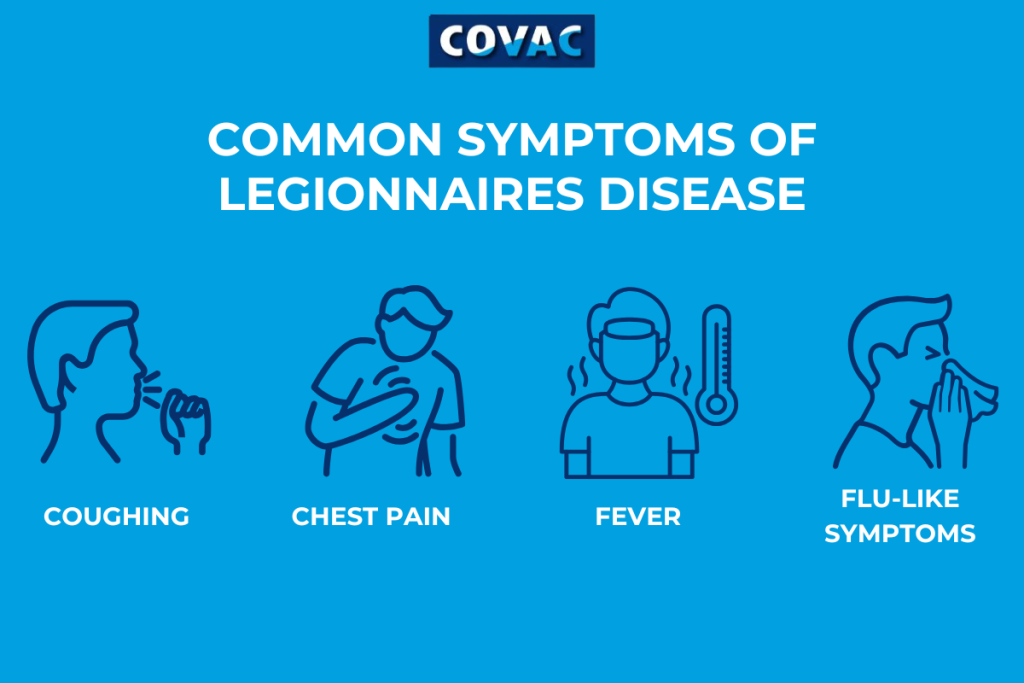
The NHS also lists common sources where droplets can be inhaled, including air conditioning systems, humidifiers, spa pools and hot tubs, and taps or showers that are not used often.
It also notes you cannot usually catch Legionnaires’ disease from drinking water or from other people.
Because the infection affects the lungs, treatment can require hospital care.
For duty holders, that makes system integrity and maintenance a matter of public safety, not just compliance paperwork.
Where Tank Refurbishment Supports Control
When internal linings deteriorate or steel begins to corrode, the tank becomes harder to keep clean. Roughness increases, deposits build more easily and biofilm becomes more likely to establish. That raises risk even where monitoring is in place, because the physical environment is doing the bacteria a favour.
This is where refurbishment becomes a practical control measure, not a cosmetic one.
Covac specialise in the repair and relining of GRP, steel and concrete water tanks using polyurethane coating systems, including Acothane DW for potable water storage.
Covac uses WRAS-approved and DWI-listed coating systems and provides a minimum 10-year guarantee.
If your tank lining is showing signs of deterioration, now is the time to act. Contact Covac to arrange a clear, compliant plan of action.